Proton Pass vs Bitwarden (2026): Which Open-Source Manager Wins?

If you've narrowed your password manager search to the two most privacy-respected options, you've landed on the right pair. Proton Pass and Bitwarden are both open-source, both end-to-end encrypted, and both independently audited — which already puts them ahead of most of the market on the thing that matters most.
So this isn't a good-versus-bad comparison. It's about which set of trade-offs fits you.
Head to head
| Proton Pass | Bitwarden | |
|---|---|---|
| Open-source | ✅ Yes | ✅ Yes |
| Independently audited | ✅ Yes | ✅ Yes |
| End-to-end encryption | ✅ Yes | ✅ Yes |
| Free plan | Usable (aliases limited) | Very generous |
| Built-in email aliases | ✅ Native (hide-my-email) | Via third-party integrations |
| Passkey support | ✅ Yes | ✅ Yes |
| Emergency access | ✅ Pass Plus | ✅ Premium |
| Self-hosting | ❌ No | ✅ Yes |
| Ecosystem | Mail, VPN, Drive | Password manager focused |
| Best for | Privacy + aliases | Free use + self-hosting |
Pricing and plan features change — confirm current details on each provider's own site.
Where Proton Pass wins
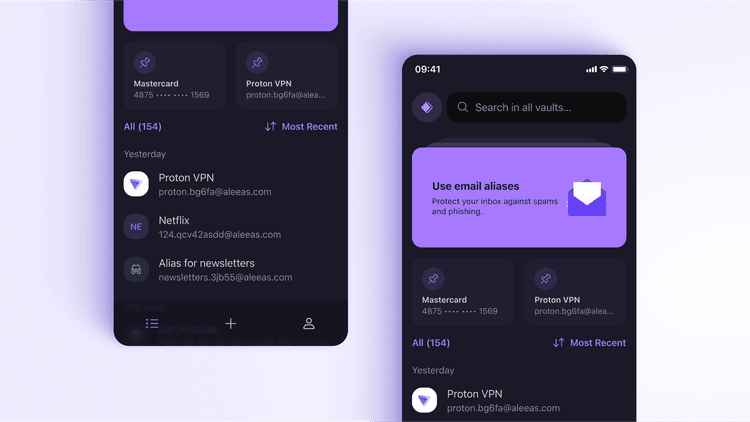
Built-in email aliases. This is the real differentiator. Proton Pass generates a random "hide-my-email" alias for each site, forwarding to your real inbox. When a site gets breached or starts spamming, you kill the alias without touching your actual address. Bitwarden can connect to third-party alias services, but Proton Pass builds it in natively — because Proton also runs the email infrastructure behind it.
The Proton ecosystem. If you use — or might use — Proton VPN, Proton Mail or Proton Drive, Pass Plus comes bundled in Proton's Unlimited plan. One privacy company, one subscription, one account.
A privacy-first company by design. Proton's entire business is privacy, based in Switzerland, funded by subscriptions rather than data. That alignment is the reason its aliases and encryption exist in the first place.
Proton Pass

“Bitwarden and Proton Pass are both excellent and both open-source, so I judged them on what's different. Proton Pass is my pick for anyone who wants their password manager to also limit how much of their identity leaks — the built-in email aliases genuinely change how exposed you are, and no amount of Bitwarden polish replaces them.”
— Jay Dabhi, Cybersecurity Analyst & Co-Founder
- Native email aliases — shield your real address on every signup
- Open-source & end-to-end encrypted, independently audited
- Bundled with Proton Mail, VPN & Drive on the Unlimited plan
- Passkey support with no ecosystem lock-in
Affiliate link · we may earn a commission at no extra cost to you.
Where Bitwarden wins
The free plan. Bitwarden's free tier is the most generous in the category — unlimited passwords across unlimited devices, no artificial caps. If your only goal is storing logins securely at zero cost, nothing beats it, and that's an honest recommendation even though it's not the pick we earn on.
Self-hosting. You can run your own Bitwarden server, keeping your vault entirely under your control. For advanced users and organizations with compliance needs, that's a real advantage Proton Pass doesn't offer.
Maturity. Bitwarden has been around longer, with a larger community, broader integrations, and a more battle-tested track record. Proton Pass is newer — excellent, but younger.
Rock-bottom premium price. Bitwarden Premium is inexpensive and adds encrypted storage, emergency access, and integrated TOTP.
Which should you choose?
- You want built-in email aliases and privacy across email, VPN and storage → Proton Pass.
- You want the best possible free password manager → Bitwarden.
- You want to self-host your vault → Bitwarden.
- You want the newer, sleeker app from a privacy-first brand → Proton Pass.
Either way you're choosing from the top of the market. Both are open-source, both are audited, and both are dramatically safer than reusing passwords — which is the actual alternative for most people. For the wider field, including the best all-in-one option, see our best password managers guide, and test any password you're keeping with our free password strength checker.
Sources & References
Frequently Asked Questions
Is Proton Pass or Bitwarden better?
They're the two best open-source password managers, and the right one depends on your priority. Proton Pass wins for privacy features — built-in email aliases, and integration with Proton Mail, VPN and Drive. Bitwarden wins on price and maturity — a famously generous free tier, cheap premium, and the option to self-host your own vault. For most privacy-focused users we lean Proton Pass; for the best free manager or self-hosting, Bitwarden.
Are both Proton Pass and Bitwarden open-source?
Yes. Both have open-source apps and have undergone independent security audits, so their end-to-end encryption claims can be verified rather than simply trusted. This is exactly why they're the two managers we recommend most to privacy-conscious users — the security isn't just asserted.
Which has the better free plan, Proton Pass or Bitwarden?
Bitwarden's free plan is the more generous of the two for pure password storage — unlimited passwords across unlimited devices with no feature nags. Proton Pass's free plan is also usable, but its standout features, especially unlimited email aliases, are reserved for Pass Plus. If you want the most capable free manager, Bitwarden; if you want aliases, Proton Pass Plus.
Does Bitwarden have email aliases like Proton Pass?
Not natively in the same way. Bitwarden offers a username generator that can connect to third-party alias services (like SimpleLogin or Fastmail), but Proton Pass builds hide-my-email aliases directly into the product and its own email infrastructure. If email aliases are a priority, Proton Pass is the more seamless option.
Can I self-host Proton Pass or Bitwarden?
Bitwarden can be self-hosted — you can run your own server instance for full control over where your vault lives, which is a genuine advantage for advanced users and organizations. Proton Pass is not self-hostable; it's a managed service, though its zero-access encryption means Proton still can't read your data.