Is My Password Strong Enough?

Passwords are the first line of defense protecting your online accounts — yet weak passwords remain one of the leading causes of account breaches worldwide.
If you’ve ever wondered “Is my password strong enough?”, you’re asking the right question.
Why Password Strength Still Matters
Despite advances in security, attackers still rely heavily on:
- Guessing weak passwords
- Credential stuffing using leaked passwords
- Automated brute-force attacks
According to breach reports, stolen or weak passwords are involved in the majority of account compromises.
Want full protection beyond link checks? Aura monitors threats, blocks phishing & protects your identity — all in one app. Save up to 63% today.
Get Aura →What Makes a Password Strong?
A strong password has three core qualities:
1. Length
Longer passwords are exponentially harder to crack.
- Minimum recommended length: 12 characters
- Stronger protection: 16+ characters
Length matters more than complexity.
2. Uniqueness
A password should be used only once.
Reusing passwords across multiple sites means:
- One breach can compromise many accounts
- Attackers can automate login attempts
Every important account should have its own unique password.
3. Unpredictability
Strong passwords avoid:
- Names
- Birthdays
- Email addresses
- Common words
- Patterns like
123456orqwerty
Randomness makes passwords resistant to guessing and automated attacks.
Common Password Mistakes to Avoid
Many people unknowingly use weak passwords by:
- Reusing the same password everywhere
- Making small variations (e.g.,
Password1,Password2) - Using short passwords for convenience
- Relying on personal information
These habits make accounts easy targets. For a full breakdown of each one and how to fix it, read common password mistakes people still make.
Are Passphrases Better Than Complex Passwords?
Yes — in most cases.
A passphrase is a longer password made of multiple random words, such as:
river-glass-harvest-cloud
Passphrases are:
- Easier to remember
- Harder to crack
- More resistant to brute-force attacks
Length and randomness are what matter most.
Should I Use a Password Manager?
Using a reputable password manager is one of the best security decisions you can make.
Password managers:
- Generate strong, unique passwords
- Store them securely
- Reduce the risk of reuse
- Make account management easier
They significantly improve overall password hygiene.
How to Check If Your Password Is Strong Enough
Before trusting a password, ask:
- Is it at least 12–16 characters long?
- Is it unique to this account?
- Does it avoid personal information?
- Has it ever been involved in a data breach?
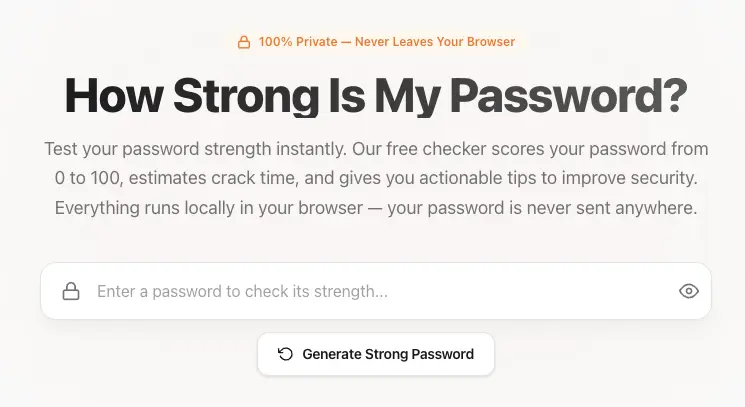
You can also use a Password Strength Checker that runs locally in your browser to evaluate strength without exposing your password.
What to Do If Your Password Is Weak or Exposed
If you suspect your password is weak or compromised:
- Change it immediately
- Replace it with a long, unique password
- Enable multi-factor authentication
- Update other accounts using the same password
- Monitor for unusual activity
Taking action early can prevent account takeover.
How Often Should You Change Your Password?
Modern guidance recommends:
- Changing passwords only if they are compromised
- Using strong, unique passwords instead of frequent changes
Forced regular changes often lead to weaker passwords.
Final Thoughts
Strong passwords are not about memorizing complexity — they’re about length, uniqueness, and smart habits.
Before trusting any password, pause and ask:
Is my password strong enough to protect this account?
A few improvements today can prevent serious problems tomorrow.
Sources & References
Frequently Asked Questions
How do I know if my password is strong enough?
A strong password is long, unique, and unpredictable. It should be at least 12–16 characters, include a mix of words or characters, and never be reused across multiple accounts.
What makes a password weak?
Passwords are weak if they are short, reused, based on common words, personal information, or patterns like '123456', 'password', or keyboard sequences.
Is using special characters required for a strong password?
Not necessarily. Length and uniqueness are more important than complexity. Long passphrases made of random words are often stronger and easier to remember than short complex passwords.
Are password managers safe to use?
Yes. Reputable password managers are considered one of the safest ways to generate and store strong, unique passwords for every account.
What should I do if my password was exposed in a data breach?
If your password was exposed, change it immediately everywhere it was used, enable multi-factor authentication, and avoid reusing that password again.