Do I Need Identity Theft Protection? (2026 Guide)

Identity theft is no longer something that only happens to celebrities, executives, or the unlucky few.
The short answer: if you bank online, shop online, or have ever received a notice that your information was exposed in a breach — which describes most adults in 2026 — then identity theft protection is genuinely worth considering. The real question isn't really whether the risk exists. It's whether you'd actually notice if someone were already using your identity right now.
Below, I'll walk through a practical framework for answering that question for your specific situation — not a blanket "everyone needs this" pitch, but an honest, evidence-based way to decide for yourself.
Fast Facts: Why This Question Matters More Than Ever
- Americans reported losing more than $12.5 billion to fraud in 2024 — a 25% jump from the year before — according to the Federal Trade Commission.
- The FTC's IdentityTheft.gov received over 1.1 million identity theft reports in 2024 alone, making identity theft one of the top categories in the agency's entire Consumer Sentinel Network.
- The FBI's Internet Crime Complaint Center (IC3) logged roughly $20.9 billion in reported cybercrime losses in its most recent annual report — a year-over-year increase of about 26%.
- Publicly reported data breaches hit a record high in 2025, according to the Identity Theft Resource Center, continuing a multi-year upward trend.
These aren't abstract statistics. Each one represents a real person who clicked a link, signed up for a service, or simply existed in a company's database that later got breached — often with no warning at all.
What Is Identity Theft Protection?
Identity theft protection services continuously monitor your personal information and alert you the moment it shows up somewhere it shouldn't — typically long before you'd notice on your own.
This usually includes monitoring for:
- Data breaches involving your email addresses, passwords, or accounts
- Dark web marketplaces where stolen personal data is bought and sold
- New accounts or credit lines opened in your name
- Suspicious changes to your credit file across all three bureaus
- Misuse of your Social Security number
The goal isn't to make you "unhackable" — no service can promise that. It's to shrink the gap between "my data was exposed" and "I found out about it," because that gap is where almost all of the real financial and emotional damage happens.
Why Identity Theft Is More Common Than Ever
A decade ago, identity theft mostly meant a stolen wallet or a scammer rifling through your mailbox. Today, it's an industrial-scale data problem that doesn't require attackers to ever interact with you directly.
Common ways your information gets exposed include:
- Corporate data breaches — a company you've never directly dealt with can leak your data through a vendor, partner, or contractor
- Phishing attacks — fake emails and texts engineered to trick you into handing over credentials
- Malicious or spoofed websites — pages built to imitate your bank, employer, or a delivery service
- Reused or weak passwords — a single leaked password can unlock dozens of unrelated accounts
- Lost or stolen devices — phones and laptops that aren't encrypted or properly locked
Once your data is exposed, it rarely stays in one place. It gets bundled, resold, and combined with other leaked records to build a more complete — and more dangerous — profile of you. That's part of why a breach from years ago can suddenly resurface and cause problems today.
🎙️ Expert Insight — Jay Dabhi, Cybersecurity Analyst: "In the cases I've reviewed over the years, the pattern is almost always the same: the breach happened months — sometimes years — before the victim noticed anything wrong. By the time they spotted a strange charge or a collections call about an account they never opened, the trail had gone cold. The people who catch it early are rarely the ones who 'got lucky.' They're the ones who had something actively watching on their behalf."
7 Signs You May Need Identity Theft Protection
1. You've Been Part of a Data Breach
If you've ever received an email that opens with "We're writing to inform you that your information may have been involved in a security incident…" — you're not in a hypothetical risk category anymore. You're in a confirmed one. Even if nothing has gone wrong yet, your data is now circulating somewhere you can't see or control.
2. You Reuse Passwords Across Sites
This remains one of the most common — and most exploitable — habits online. Attackers run leaked username/password combinations against hundreds of other websites in a technique called credential stuffing. A single reused password from a breach you don't even remember can hand over your email, banking, or shopping accounts in seconds.
3. You Shop or Bank Online Regularly
Every account you create is another place where your name, address, payment details, and sometimes your Social Security number live. The convenience is real, but so is the expanding attack surface — the more digital footprints you leave, the more places a criminal can pick up your trail.
4. You Use Digital or Mobile Banking
Financial accounts are usually the end goal for identity thieves; everything else — your email, your SSN, your address — is typically just a stepping stone to get there. If your financial life lives mostly on your phone or in a browser tab, that's exactly where active monitoring matters most.
5. You're Suddenly Getting a Lot More Scam Messages
A sudden spike in phishing emails, "your package couldn't be delivered" texts, or "suspicious login" alerts you didn't trigger is rarely a coincidence. It often means your contact information recently surfaced in a fresh breach or data dump being circulated among scammers.
6. You Have Kids, Aging Parents, or Other Family Online
Children's Social Security numbers are especially valuable to identity thieves because the fraud can go undetected for years — nobody checks a 10-year-old's credit report. Older adults, meanwhile, are disproportionately targeted by impersonation and tech-support scams. If you're the one who'd have to clean up the mess, their exposure is effectively your exposure too.
7. You Don't Actively Monitor Your Accounts or Credit
Be honest: when's the last time you checked your credit report, reviewed a full bank statement line by line, or searched your email address against a breach database? Most people only discover identity theft after the damage is done — a denied loan application, a debt collector calling about an account they never opened, or a tax return rejected because someone already filed using their SSN.
Quick Self-Check: How Exposed Are You?
Give yourself one point for each statement below that's true for you:
- I've received a data breach notification in the past few years
- I reuse the same (or a very similar) password on more than one site
- I shop online or use delivery / ride-share apps regularly
- I do most of my banking through a phone app or website
- I've noticed more scam emails, texts, or calls than usual recently
- I have children or older family members who are active online
- I haven't checked my credit report or run a personal data search in the last year
What your score means:
- 0–2 points — Your exposure is comparatively low. Strong, unique passwords plus a free credit-monitoring tool may be enough for now.
- 3–5 points — You're in the zone where most people land. This is where paid monitoring starts to earn its cost — the early alerts alone can save you weeks of cleanup later.
- 6–7 points — Your exposure is high. Dedicated identity theft protection isn't a luxury at this point; it's closer to a baseline precaution.
Who Probably Doesn't Need Identity Theft Protection?
In the interest of giving you a straight answer rather than a sales pitch — not everyone needs to pay for this.
You're a reasonable candidate to hold off if you:
- Rarely use online banking, shopping, or social accounts
- Already use a password manager with unique passwords everywhere
- Actively review your credit reports and account statements
- Already run multiple security layers (2FA, antivirus, breach alerts)
That said, after spending years looking at how these cases actually unfold, I'd estimate this describes a fairly small slice of people — and even then, "lower risk" doesn't mean "no risk." A single breach at a company you've never personally interacted with can change your exposure overnight, with zero warning.
Free Monitoring vs. Paid Protection: An Honest Comparison
| Free Monitoring | Paid Protection (e.g., Aura) | |
|---|---|---|
| Cost | $0 | Roughly $10–$30/month |
| What it covers | Usually one slice — credit or email breach alerts | Identity, 3-bureau credit, dark web, SSN, financial accounts, devices |
| Alert speed | Often delayed or periodic | Real-time monitoring and alerts |
| Recovery support | Generally none — you're on your own | Dedicated case managers, often with insurance backing |
| Best fit | Light internet users on a tight budget | Anyone who banks, shops, or has prior breach exposure |
Free tools aren't worthless — they're a reasonable starting point. But they tend to cover a single slice of your digital life and rarely offer help if something actually goes wrong. Paid services are generally built around the assumption that, eventually, something will.
What Should You Actually Look For in a Paid Service?
Not all identity theft protection is built the same. Before committing to one, confirm it includes:
- Data breach monitoring — alerts when your accounts surface in known leaks
- Dark web monitoring — scans of marketplaces where stolen data is traded
- Credit monitoring — ideally across all three bureaus, not just one
- SSN and financial account monitoring — not just your email address
- Safe browsing / anti-phishing tools — to stop threats before they reach you
- Identity restoration support — real people who help you recover, not just a help-center article
- Insurance backing — reimbursement for stolen funds and recovery-related expenses
- Family or household plans — useful if you're also covering kids or aging parents
Our Recommendation
For most people, the smartest move isn't stitching together five different free tools and hoping they overlap correctly. It's choosing one platform that covers the essentials — and actually helps if something goes wrong.
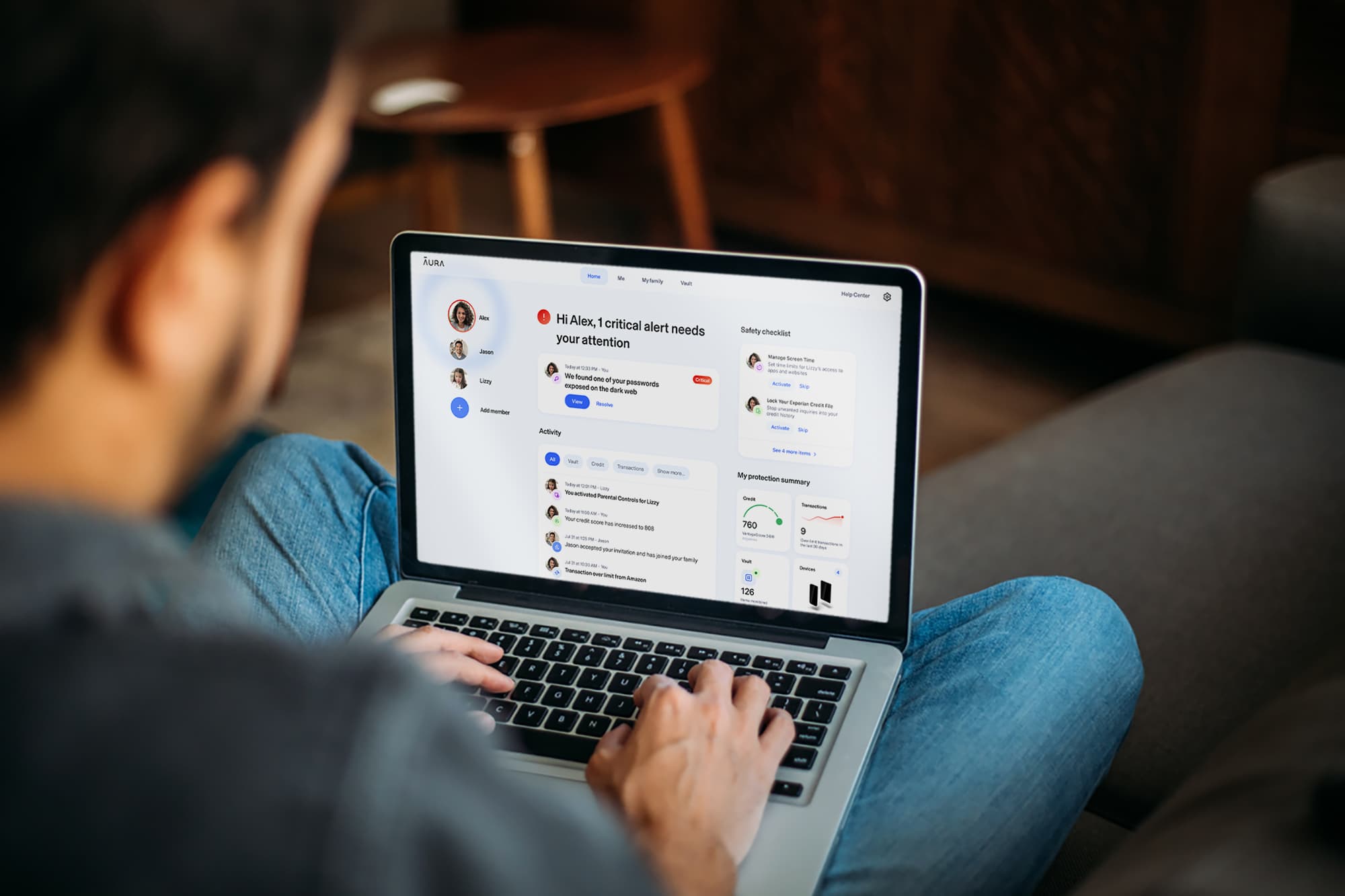

 Recommended
Award-Winning Online Safety — All in One Place
Aura brings together everything you need to stay safe online — identity monitoring, credit protection, VPN, antivirus, and a password manager — in a single, easy-to-use platform. Ranked best in class by Forbes Advisor, US News, and Money.
$1M
Identity Insurance per adult
3
Credit bureaus monitored
4.6★
Trustpilot rating
24/7
U.S.-based expert support
* Affiliate link. We may earn a commission at no extra cost to you.
Aura combines identity monitoring, three-bureau credit monitoring, a VPN, antivirus, a password manager, and up to $1M in identity theft insurance into a single app — the kind of "set it up once and let it watch your back" setup that people actually keep using months later, instead of abandoning after the first week.
For a closer look at pricing, features, and our editorial rating, see our full Aura review.
Is Identity Theft Protection Actually Worth the Cost?
Run the math for your own situation. If you have:
- Multiple online accounts tied to your name and email
- Active digital or mobile banking
- Stored payment methods on shopping or delivery apps
- A previous breach notification — even one you brushed off at the time
…then for most people, the honest answer is yes.
Here's the comparison that actually matters: a monitoring subscription costs roughly the same as a single streaming service. Recovering from identity theft, by contrast, regularly costs victims dozens of hours of phone calls, paperwork, and disputes — and in serious cases, months of follow-through — on top of any direct financial loss. The math tends to favor prevention, and it isn't particularly close.
Want full protection beyond link checks? Aura monitors threats, blocks phishing & protects your identity — all in one app. Save up to 63% today.
Get Aura →Strengthen the Rest of Your Defenses
Identity monitoring is one critical layer — but it works best alongside good day-to-day habits, especially around passwords, since weak or reused credentials are still how most accounts get compromised in the first place.
Is your password strong enough?
Test any password instantly with our free checker. Strength analysis runs entirely in your browser — nothing is ever transmitted or stored.
If you want to go deeper on that side of things, these guides are a good next step:
- Is My Password Strong Enough?
- Common Password Mistakes People Still Make
- How Hackers Steal Passwords
And if you'd like to compare dedicated identity protection services side by side before deciding, see our full breakdown: Best Identity Theft Protection Services (2026).
Final Verdict
If your personal information exists online — and for nearly everyone reading this, it does — identity theft protection is worth seriously considering. Not because something is guaranteed to go wrong, but because you likely won't see it coming if it does.
You may never need it. Most people who have it never end up filing a claim. But the people who do need it almost never know in advance — they find out the same way everyone else does: later than they'd like, and grateful something was watching when it happened.
So instead of asking:
"Do I need identity theft protection?"
Ask the question that actually matters:
"If someone opened an account in my name today, how long would it take me to find out?"
If your honest answer is "I'm not sure" — that's your answer.
Sources & References
Frequently Asked Questions
Do I really need identity theft protection?
Identity theft protection is not mandatory, but it can help detect fraud, data breaches, and identity misuse early. Individuals with multiple online accounts, stored financial information, or previous breach exposure benefit the most — which, per FTC reporting data, now describes the majority of internet users.
Who should get identity theft protection?
Anyone who shops online, uses digital banking, stores sensitive information online, or has been notified of a data breach should seriously consider it. People managing accounts for children or aging parents should weigh it even more heavily, since both groups are common fraud targets.
Can identity theft protection prevent identity theft?
No service can prevent every incident — no company can stop a breach at a business you've never even heard of. What it can do is shrink the time between exposure and detection, which is the single biggest factor in how much damage fraud actually causes.
What is the difference between credit monitoring and identity theft protection?
Credit monitoring focuses narrowly on changes to your credit file and score. Identity theft protection is broader — it typically also covers data breach alerts, dark web monitoring, SSN misuse, financial account activity, safe browsing tools, and recovery assistance if something does go wrong.
How much does identity theft protection cost?
Most reputable services run roughly $10-$30 per month depending on the plan and number of people covered, which is comparable to a streaming subscription. Family and household plans typically cost more but cover multiple people, including children, under one account.
What should I do if I think my identity has already been stolen?
Act quickly: place a fraud alert or credit freeze with the three credit bureaus, report the incident at IdentityTheft.gov to get a personalized recovery plan, change passwords on affected (and reused) accounts, and monitor your statements closely for the following months. A service with identity restoration support can also assign a case manager to help you through the process.
Is identity theft protection worth paying for?
For most people — especially those with multiple online accounts, digital banking, or previous breach exposure — yes. The monthly cost is typically far lower than the time, stress, and potential financial loss involved in recovering from identity theft after the fact.